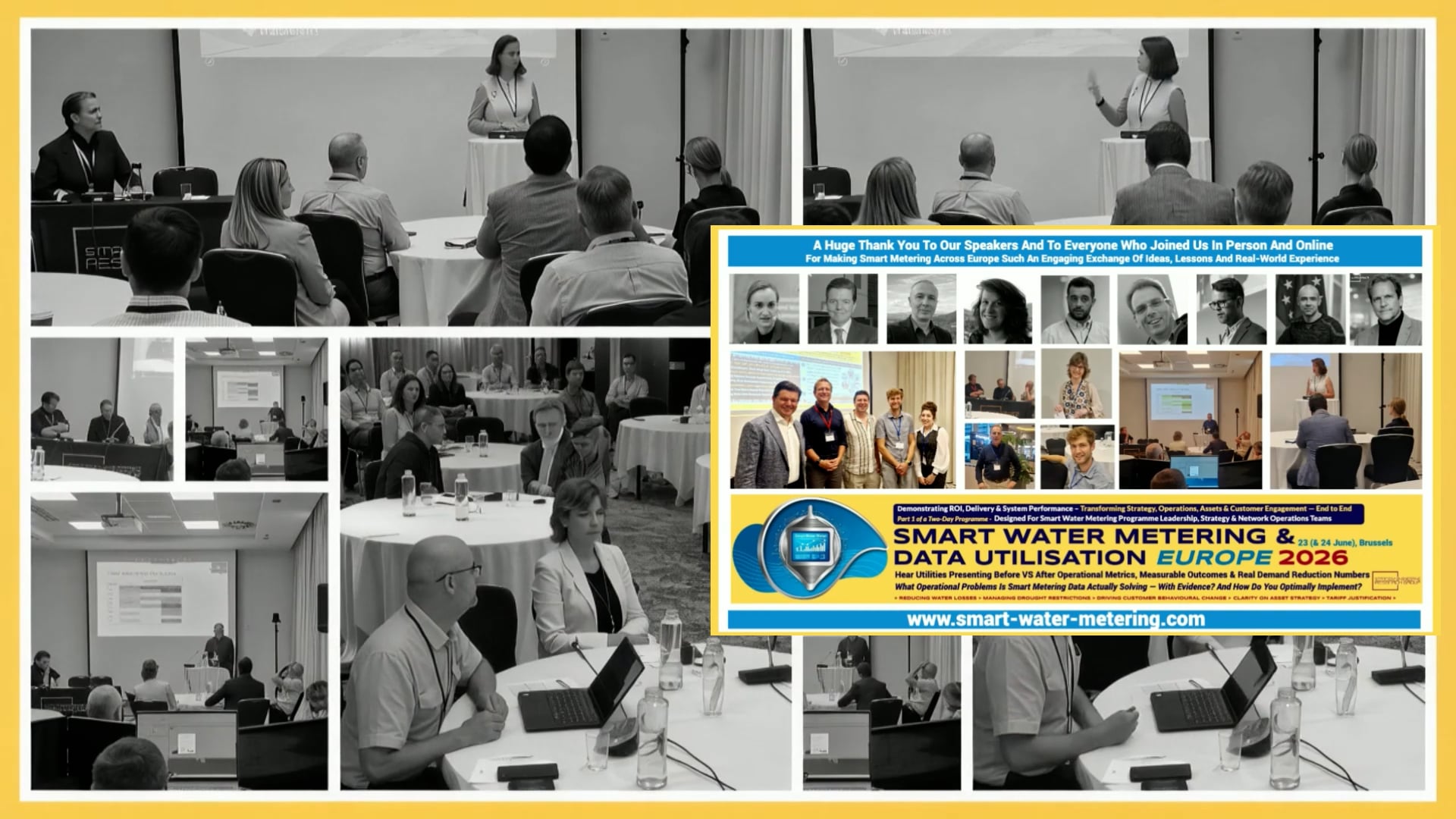
Frederic De Vrieze, Member of the Board, CX Brussels
Do Not Lead With Technology. Lead With Trust, Purpose And Customer Benefit.
Frederik opened by saying that if utilities want to change customer behaviour, it has to be built around trust. Smart metering will not be accepted simply because the utility says it is necessary. Customers need to understand why it matters and why they should believe in it.
He acknowledged that there is reluctance in Belgium toward smart metering. Some customers are suspicious, resistant or worried about the implications of the technology.
Communication Should Explain The “Why”, Not Just The Installation Process
Frederik repeatedly stressed that customers need to be properly informed. The issue is not just telling them a meter is being changed, but explaining why the change is important.
Leak Detection Should Be Framed As Customer Protection, Not Just Operational Efficiency
He gave the example of an elderly couple receiving a €75,000 bill after a leaking or burst pipe. His point was that smart metering could have detected the problem earlier and prevented a catastrophic financial shock.
Frederik said customers need to understand that smart metering can reduce their bill or help prevent extreme bills caused by undetected leaks.
The strongest customer message is not “we are digitalising”. It is “we can help protect you from waste, leaks and unexpected costs.”
When asked how to manage customers who do not understand, trust or accept the move from dumb meters to smart meters, Frederik said the answer is to inform people well rather than simply impose the technology.
A rollout that feels imposed risks creating resistance. A rollout that feels explained has a much better chance of acceptance.
Frederik referenced Sibelga, the Brussels network operator, which ran an information campaign to convince customers why smart metering mattered.
Smart metering needs campaign thinking, not just operational notices.
Sibelga did not run one generic rollout message. They segmented by customer type, including one-person households, SMEs, building size and apartment buildings.
Smart metering communications should be segmented like a customer campaign, not broadcast like a utility notice.
Frederik said Sibelga followed up with customer feedback to understand whether people were satisfied with implementation.
Customer satisfaction should be measured during rollout, not only after complaints appear.
One of his strongest practical points was that the technician installing the meter made a major difference to customer satisfaction when they explained the change properly.
Do Not Wait For Customer Resistance. Get Ahead Of It
He repeatedly stressed the need to be proactive. Customers should be informed before problems escalate and before misinformation fills the gap.
Do Not Assume Smart Metering Communication Should Only Be Digital. Paper Can Still Cut Through, Especially With Older Or Less Digitally Engaged Customers
In response to Sophia’s point about reaching less digitally savvy customers, Frederik said letters are now rare enough that they can be powerful: if people receive a letter, they tend to read it.
When asked about data granularity, Frederik said utilities can have too much data. The important thing is having the right data.
The question is not “how much data can we collect?” It is “which data helps customers and utilities make better decisions?”
Frederik suggested utilities could apply marketing segmentation and A/B testing to understand what works.
Customer engagement should be tested and optimised. Utilities should not assume the first message is the right message.
He said the smart metering campaign and the changes around it happen in several phases. Utilities can compare old and new customers, understand benefits and then improve the communications that follow.
Customer engagement should evolve through the programme. It should not be a one-off launch communication.
The Post-Installation Phase Is Where Customer Understanding And Behaviour Change Either Develop Or Disappear
Frederik said the communication after the study or rollout is very important. In other words, the customer journey does not end once the meter is installed.
When asked about failures or things to avoid, Frederik said the key customer experience principle is to be proactive rather than reactive. Waiting for something to go wrong and then waiting for the customer to contact the utility is the wrong approach.
He warned against expecting customers to log into a portal to discover important information. If the utility already has the numbers, it should send alerts rather than wait for customers to find the issue themselves.
Portals are useful for engaged customers, but they are weak as the main behavioural-change mechanism.
Frederik said utilities should send alerts where they have the data, rather than passively waiting for customers to consult a platform.
Critical information should be pushed to the customer, not hidden behind a login.
Gamification May Help Reduce Consumption
Behaviour change can be made more engaging, but it needs to be applied selectively.
He suggested that utilities could use gamification to help customers see how they can reduce water use, especially where regions are facing real water stress.
When asked whether gamification works across all segments, Frederik said it may work more for Gen Z, but utilities must look at what works for each segment. Some customers may respond better to direct alerts, clear information or financial impact.
One engagement method will not work across the whole customer base.
Frederik referenced his conversation with DEWA, where smart metering is essential because water comes from desalination and is understood as precious. He contrasted this with Europe, where people have historically opened the tap and assumed water will always flow.
European utilities need to help customers understand that water resilience is no longer guaranteed.
He said the future will be different, and that this is when measures such as smart metering become necessary.
Smart metering should be linked to the wider water resilience story, not just billing or operational efficiency.